
Infected Separated-Type Subdural Hematoma: A Rare Clinical Variant?
Schlagwörter:
Subdural Hematoma (SDH), Infected Subdural Hematoma, Traumatic Head Injury, Burr-holeAbstract
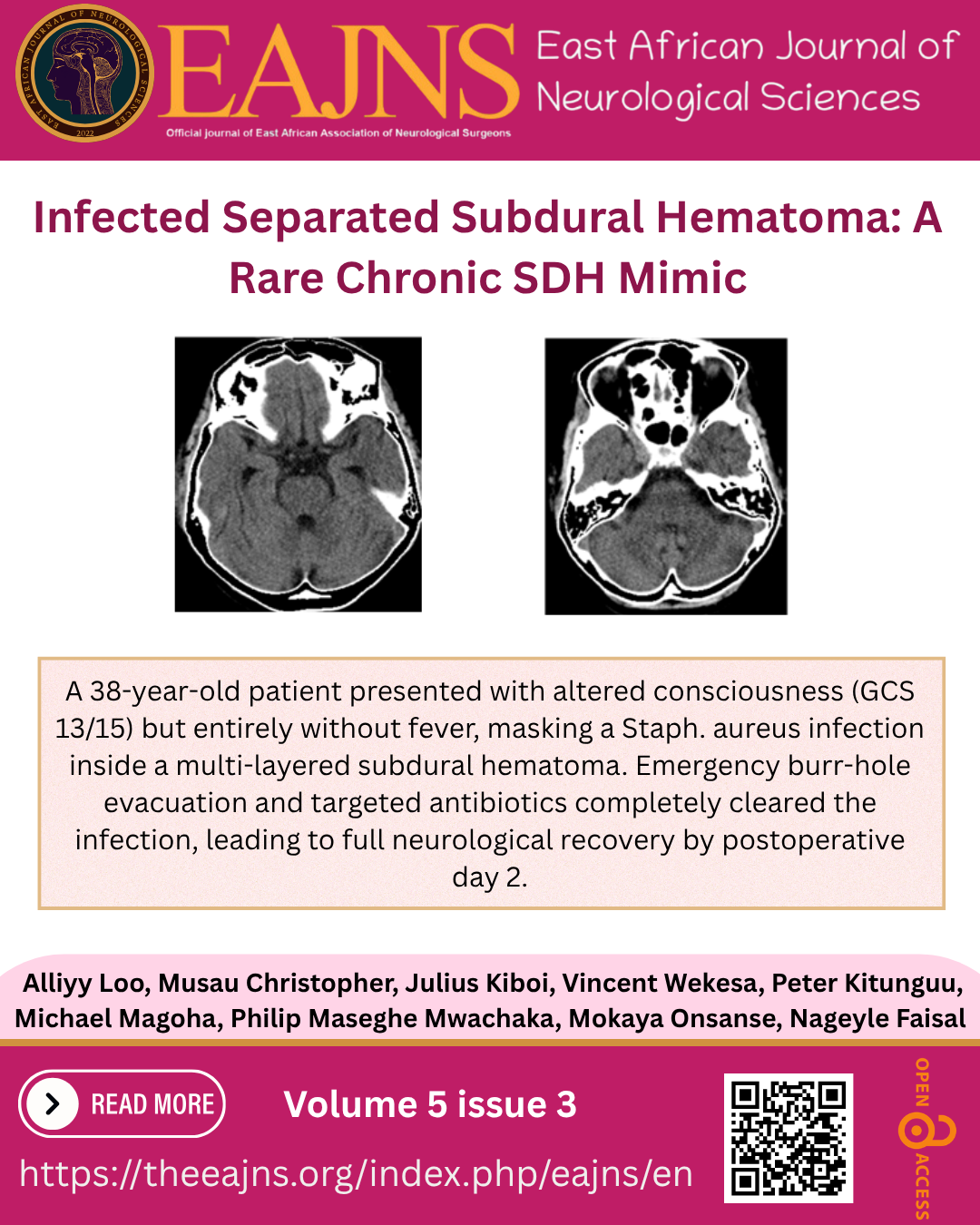
Background: Subdural haematoma (SDH) is a prevalent neurosurgical emergency, and its pathophysiology is consistently advancing with the discovery of novel varieties. The separated or multi-layered type, first described by Nakaguchi et al., is a unique pathoanatomic entity with particular imaging and clinical features. Case summary: This report details a rare case of an infected separated-type subdural haematoma in a 38-year-old female with a history of chronic alcohol use, intravenous drug use and head injury. She presented in a comatose condition without fever or focal neurological abnormalities. An axial non-contrast CT scan showed a right fronto-parietal subdural collection with multiple internal septations. We performed burr hole evacuation. Microbiological culture of the drained subdural contents revealed Staphylococcus aureus sensitive to cefotaxime, meropenem, and ceftriaxone. The patient regained full consciousness after the evacuation, and neurological function was intact within 24 hours. Infection of existing subdural hematomas by haematogenous methods is a rare yet complex condition commonly associated with immunosuppression, chronic alcohol use and old age. Common microbes isolated include Staphylococcus aureus, E. coli, H. influenzae, and Salmonella species. Conclusion: Infected separated-type SDH constitute a rare yet significant variant of chronic SDH. This condition is often misdiagnosed as a simple chronic subdural hematoma. Rapid diagnosis and appropriate antibiotic management are crucial to patient outcomes.
Downloads
Literaturhinweise
Tamai S, Watanabe T, Ichinose T, Murakami KI, Ueno M, Munemoto S, et al. Morphological characteristics of infected subdural hematoma: Comparison with images of chronic subdural hematoma. Clin Neurol Neurosurg. 2020 Jul;194:105831. doi:10.1016/j.clineuro.2020.105831 PubMed PMID: 32294578.
Dabdoub CB, Adorno JO, Urbano J, Silveira EN, Orlandi BMM. Review of the Management of Infected Subdural Hematoma. World Neurosurgery. 2016 Mar 1;87:663.e1-663.e8. doi:10.1016/j.wneu.2015.11.015
Yamamoto S, Asahi T, Akioka N, Kashiwazaki D, Kuwayama N, Kuroda S. Chronic Subdural Hematoma Infected by Propionibacterium Acnes: A Case Report. Case Rep Neurol. 2015 Jan 24;7(1):6–14. doi:10.1159/000371841
Aoki N, Sakai T, Oikawa A, Takizawa T, Shishido T. Infected Subdural Effusion Associated with Resolving Subdural Hematoma —Case Report—. Neurologia medico-chirurgica. 1997;37(8):637–9. doi:10.2176/nmc.37.637
Mehmandoost M, Bahri A, Hasheminejad A, Sharifi H, Oveisi S, Fahim F. Prevalence, etiology, risk factors, management options, and outcomes in chronic subdural hematoma (cSDH): A comprehensive literature review of recent advances. Brain Disorders. 2025 Sep 1;19:100271. doi:10.1016/j.dscb.2025.100271
Zhu X, Cheng J, Yang T, Fan K, Ma Y, Yang Y. Updates in Chronic Subdural Hematoma: From Epidemiology, Pathogenesis, and Diagnosis to Treatment. Neurosurgical Subspecialties. 2025 Sep 30;1(3):115–24. doi:10.14218/NSSS.2025.00023
Catana D, Koziarz A, Cenic A, Nath S, Singh S, Almenawer SA, et al. Subdural Hematoma Mimickers: A Systematic Review. World Neurosurgery. 2016 Sep 1;93:73–80. doi:10.1016/j.wneu.2016.05.084
French H, Schaefer N, Keijzers G, Barison D, Olson S. Intracranial Subdural Empyema: A 10-Year Case Series. Ochsner Journal. 2014 Jun 20;14(2):188–94. PubMed PMID: 24940128.
Brust JCM. Neurologic Complications of Illicit Drug Abuse. Continuum. 2014 Jun;20(3):642–56. doi:10.1212/01.CON.0000450971.99322.cd
Hoang AN, Shah V, Granger J, III DD, Youssef PP, Powers CJ, et al. Intravenous Drug Use‐Associated Endocarditis Leads to Increased Intracranial Hemorrhage and Neurological Comorbidities. Stroke: Vascular and Interventional Neurology. 2023 Sep;3(5):e000806. doi:10.1161/SVIN.122.000806
Iimura Y, Tsutsumi S, Mitome Y, Nonaka Y, Abe Y, Yasumoto Y, et al. Infantile Chronic Subdural Hematoma Infected by Escherichia Coli. Neurologia medico-chirurgica. 2010;50(6):482–4. doi:10.2176/nmc.50.482
Dubinski D, Won SY, Rafaelian A, Duran SH, Rohwer M, Freitag T, et al. Subclinical low-grade infection in untreated primary chronic subdural hematoma [Internet]. 2025 Nov 7. doi:10.3171/2025.7.JNS251083
Rout P, Badireddy M. Hyponatremia. In: StatPearls [Internet] [Internet]. StatPearls Publishing; 2025 [cited 2026 Mar 31]. Available from: https://www.ncbi.nlm.nih.gov/books/NBK470386/ PubMed PMID: 29262111.
Nakaguchi H, Tanishima T, Yoshimasu N. Factors in the natural history of chronic subdural hematomas that influence their postoperative recurrence. J Neurosurg. 2001 Aug;95(2):256–62. doi:10.3171/jns.2001.95.2.0256 PubMed PMID: 11780895.
Arboix A, Bechich S, Oliveres M, García-Eroles L, Massons J, Targa C. Ischemic stroke of unusual cause: clinical features, etiology and outcome. Eur J Neurol. 2001 Mar;8(2):133–9. doi:10.1046/j.1468-1331.2001.00180.x PubMed PMID: 11430270.
Downloads
Veröffentlicht
Lizenz
Copyright (c) 2026 East African Journal of Neurological Sciences

Dieses Werk steht unter der Lizenz Creative Commons Namensnennung - Nicht-kommerziell - Keine Bearbeitungen 4.0 International.


