
The Effect Of Impaired Blood-Brain Barrier In Seizure Control And Response To Anti-Seizure Medication During Paediatric Acute Symptomatic Seizures Due To Severe Falciparum Malaria
Keywords:
Cerebrospinal fluid proteins, acute symptomatic seizures, anti-seizure medications, AfricaAbstract
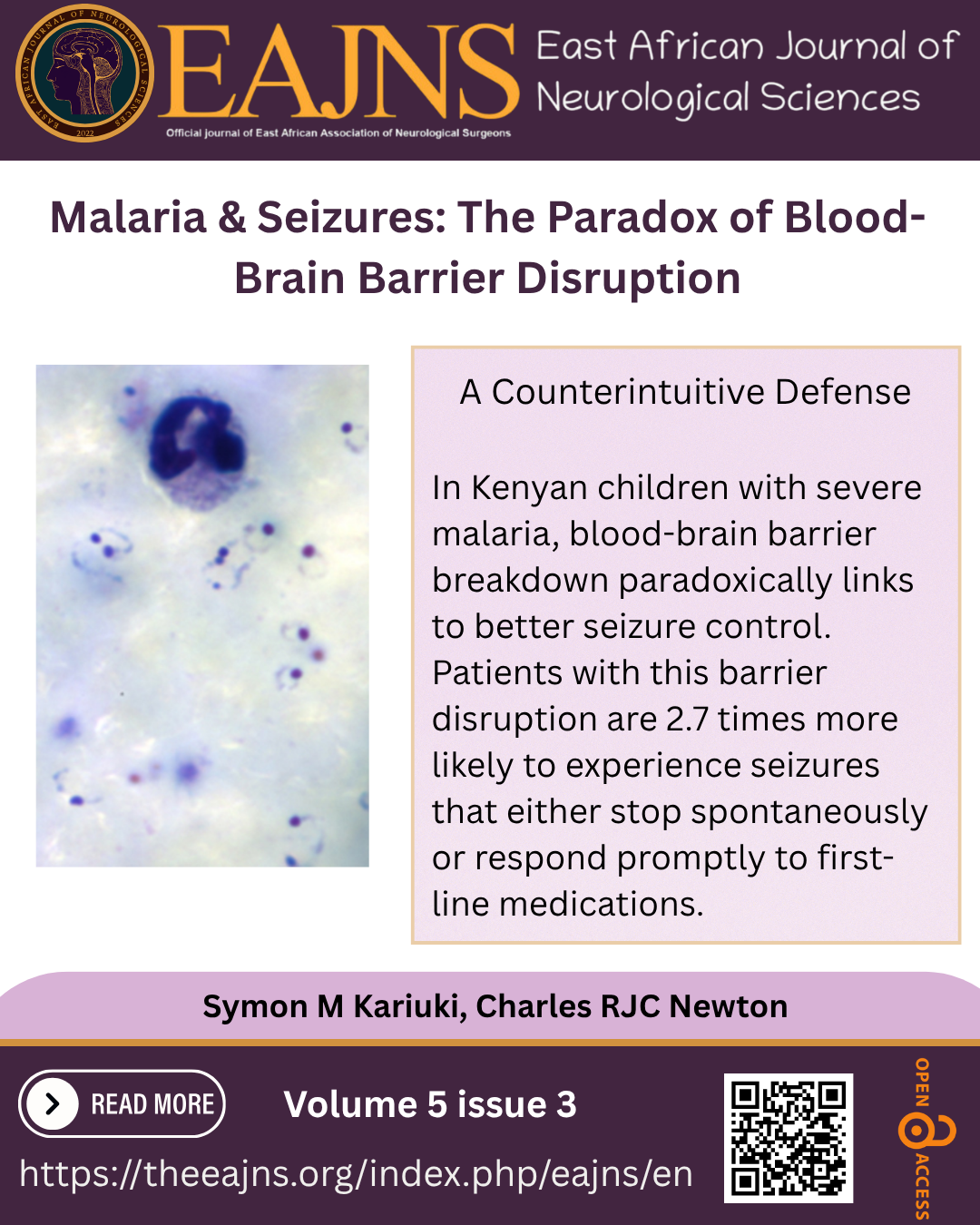
Background: Blood–brain barrier disruption is documented in severe falciparum malaria, but the role of the cerebrospinal fluid (CSF) proteins on pathogenesis and control of acute symptomatic seizures is not studied. We hypothesised that elevated CSF proteins (markers of blood-brain breakdown) in children admitted to the hospital with severe malaria may affect the risk for seizures in malaria and seizure control or response to anti-seizure medications (ASM). Objective: We measured CSF and plasma total protein, albumin, ferritin, and S100B concentrations in children with severe malaria to determine their associations with the risk of acute symptomatic seizures, seizure control, and response to ASM. Methods: We measured CSF levels of proteins such as albumin, ferritin and S100B (a glial biomarker), in 45 children with carefully phenotyped seizures in the context of severe falciparum malaria admitted to hospital and documented the response of these seizures to ASM. We compared the distribution of these proteins in those with and without seizures, and in those requiring second-line ASM versus those controlled on first-line ASM. We further documented the occurrence of acute symptomatic seizures in those with evidence of blood–brain barrier disruption. Results: In the 45 children with severe falciparum malaria who had CSF protein levels measured, 36 of 45 (80.0%) had acute symptomatic seizures, of which 32 of 36 (88.9%) were complex seizures (focal, repetitive and/or prolonged). One unit increase in CSF Protein S100B levels (ng/mL) was associated with acute symptomatic seizures ((adjusted risk ratio (aRR)=1.06 (95%CI:1.01-1.11); P=0.012)). Acute symptomatic seizures, stopping spontaneously or without requiring second-line ASM, was associated with a one-unit increase in CSF ferritin levels (ng/mL) (aRR=1.12 (95%CI:1.03-1.23); P=0.008), CSF S100B levels (ng/mL) (aRR=1.33 (95%CI:1.00-1.78); P=0.051) and CSF total proteins levels (mg/L) (aRR=1.01 (95%CI:1.00-1.01); P=0.023). Seizures, responding to first-line ASM or stopping spontaneously, were more frequent in those with blood–brain barrier disruption compared to those without disruption (aRR=2.72 (95%CI:1.08-6.83); P=0.032). Evidence of blood–brain barrier disruption was associated with simple seizures. Conclusion: Elevated CSF proteins may be associated with anti-seizure activity in Kenyan children with acute symptomatic seizures admitted to hospital with severe falciparum malaria. Protein S100BB appears to be context-dependent in being involved in both the pathogenesis of acute symptomatic seizures in malaria, and in promoting a compensatory response for seizure control. Future well-powered longitudinal studies are required to confirm these findings.
Downloads
References
1. Kariuki SM, Abubakar A, Kombe M, Kazungu M, Odhiambo R, Stein A, et al. Prevalence, risk factors and behavioural and emotional comorbidity of acute seizures in young Kenyan children: a population-based study. BMC Med. 2018;16(1):35.
2. Serem GK, Newton CR, Kariuki SM. Incidence, causes and phenotypes of acute seizures in Kenyan children post the malaria-decline period. BMC neurology. 2015;15(1):180.
3. Kariuki SM, Ikumi M, Ojal J, Sadarangani M, Idro R, Olotu A, et al. Acute seizures attributable to falciparum malaria in an endemic area on the Kenyan coast. Brain. 2011;134(Pt 5):1519-28.
4. Bistervels IM, Kariuki SM, Newton CRJC. Risk of convulsive epilepsy following acute seizures in Kenyan children. Epilepsia Open. 2016;1(3-4):112-20.
5. Carter JA, Mung’ala-Odera V, Neville BGR, Murira G, Mturi N, Musumba C, et al. Persistent neurocognitive impairments associated with severe falciparum malaria in Kenyan children. Journal of neurology, neurosurgery, and psychiatry. 2005;76(4):476-81.
6. Ogutu BR, Newton CR. Management of seizures in children with falciparum malaria. Tropical doctor. 2004;34(2):71-5.
7. Muchohi SN, Kokwaro GO, Ogutu BR, Edwards G, Ward SA, Newton CR. Pharmacokinetics and clinical efficacy of midazolam in children with severe malaria and convulsions. British journal of clinical pharmacology. 2008;66(4):529-38.
8. Ogutu BR, Newton CR, Crawley J, Muchohi SN, Otieno GO, Edwards G, et al. Pharmacokinetics and anticonvulsant effects of diazepam in children with severe falciparum malaria and convulsions. Br J Clin Pharmacol. 2002;53(1):49-57.
9. Ogutu BR, Newton CR, Muchohi SN, Otieno GO, Edwards G, Watkins WM, et al. Pharmacokinetics and clinical effects of phenytoin and fosphenytoin in children with severe malaria and status epilepticus. Br J Clin Pharmacol. 2003;56(1):112-9.
10. Ikumi ML, Muchohi SN, Ohuma EO, Kokwaro GO, Newton CR. Response to diazepam in children with malaria-induced seizures. Epilepsy research. 2008;82(2-3):215-8.
11. Waruiru CM, Newton CR, Forster D, New L, Winstanley P, Mwangi I, et al. Epileptic seizures and malaria in Kenyan children. Trans R Soc Trop Med Hyg. 1996;90(2):152-5.
12. Kokwaro G, Edwards G, Roberts P, Ward S, Winstanley P, Watkins W. Infection with Plasmodium berghei alters benzodiazepine receptor in rat brain. Archives of medical research. 1997;28(3):425-7.
13. Maitland K, Pamba A, Fegan G, Njuguna P, Nadel S, Newton CR, et al. Perturbations in electrolyte levels in kenyan children with severe malaria complicated by acidosis. Clinical infectious diseases: an official publication of the Infectious Diseases Society of America. 2005;40(1):9-16.
14. Raimondo JV, Burman RJ, Katz AA, Akerman CJ. Ion dynamics during seizures. Front Cell Neurosci. 2015;9:419.
15. Gitau EN, Newton CR. Review Article: blood-brain barrier in falciparum malaria. Tropical medicine & international health: TM & IH. 2005;10(3):285-92.
16. Verhoog QP, Holtman L, Aronica E, van Vliet EA. Astrocytes as Guardians of Neuronal Excitability: Mechanisms Underlying Epileptogenesis. Front Neurol. 2020;11:591690.
17. Mturi N, Keir G, Maclennan CA, Ross A, Willis AC, Elford BC, et al. Cerebrospinal Fluid Studies in Kenyan Children with Severe Falciparum Malaria. Open Trop Med J. 2008;1:56-62.
18. Remy S, Beck H. Molecular and cellular mechanisms of pharmacoresistance in epilepsy. Brain: a journal of neurology. 2006;129(Pt 1):18-35.
19. Hochman DW. The extracellular space and epileptic activity in the adult brain: explaining the antiepileptic effects of furosemide and bumetanide. Epilepsia. 2012;53 Suppl 1(Suppl 1):18-25.
20. Zareifar S, Hosseinzadeh HR, Cohan N. Association between iron status and febrile seizures in children. Seizure - European Journal of Epilepsy. 2012;21(8):603-5.
21. Clark MA, Goheen MM, Cerami C. Influence of host iron status on Plasmodium falciparum infection. Front Pharmacol. 2014;5:84.
22. Goyal A, Failla MD, Niyonkuru C, Amin K, Fabio A, Berger RP, et al. S100B as a prognostic biomarker in outcome prediction for patients with severe traumatic brain injury. J Neurotrauma. 2013;30(11):946-57.
23. Njuguna P, Newton C. Management of severe falciparum malaria. J Postgrad Med. 2004;50(1):45-50.
24. Luxton RW, Patel P, Keir G, Thompson EJ. A micro-method for measuring total protein in cerebrospinal fluid by using benzethonium chloride in microtiter plate wells. Clinical chemistry. 1989;35(8):1731-4.
25. McLean BN, Luxton RW, Thompson EJ. A study of immunoglobulin G in the cerebrospinal fluid of 1007 patients with suspected neurological disease using isoelectric focusing and the Log IgG-Index. A comparison and diagnostic applications. Brain: a journal of neurology. 1990;113 ( Pt 5):1269-89.
26. Scheffer IE, Berkovic S, Capovilla G, Connolly MB, French J, Guilhoto L, et al. ILAE classification of the epilepsies: Position paper of the ILAE Commission for Classification and Terminology. Epilepsia. 2017;58(4):512-21.
27. Ma A, Wang C, Chen Y, Yuan W. P-glycoprotein alters blood-brain barrier penetration of antiepileptic drugs in rats with medically intractable epilepsy. Drug design, development and therapy. 2013;7:1447-54.
28. Rosen AS, Andrew RD. Osmotic effects upon excitability in rat neocortical slices. Neuroscience. 1990;38(3):579-90.
29. Schwartzkroin PA, Baraban SC, Hochman DW. Osmolarity, ionic flux, and changes in brain excitability. Epilepsy research. 1998;32(1-2):275-85.
30. Barffour MA, Schulze KJ, Coles CL, Chileshe J, Kalungwana Na, Siamusantu W, et al. Malaria exacerbates inflammation-associated elevation in ferritin and soluble transferrin receptor with only modest effects on iron deficiency and iron deficiency anaemia among rural Zambian children. Tropical Medicine & International Health. 2018;23(1):53-62.
31. Medana IM, Idro R, Newton CR. Axonal and astrocyte injury markers in the cerebrospinal fluid of Kenyan children with severe malaria. Journal of the neurological sciences. 2007;258(1-2):93-8.
32. Goyette J, Geczy CL. Inflammation-associated S100B proteins: new mechanisms that regulate function. Amino Acids. 2011;41(4):821-42.
33. Sinha P, Okoro C, Foell D, Freeze HH, Ostrand-Rosenberg S, Srikrishna G. Proinflammatory S100B proteins regulate the accumulation of myeloid-derived suppressor cells. J Immunol. 2008;181(7):4666-75.
34. Sharma V, Babu PP, Singh A, Singh S, Singh R. Iron-induced experimental cortical seizures: Electroencephalographic mapping of seizure spread in the subcortical brain areas. Seizure. 2007;16(8):680-90.
35. Zimmer TS, David B, Broekaart DWM, Schidlowski M, Ruffolo G, Korotkov A, et al. Seizure-mediated iron accumulation and dysregulated iron metabolism after status epilepticus and in temporal lobe epilepsy. Acta Neuropathol. 2021;142(4):729-59.
36. Thaele A, Barba L, Abu-Rumeileh S, Foschi M, Otto M. Neurofilament light chain and glial fibrillary acidic protein as diagnostic and prognostic biomarkers in epileptic seizures and epilepsy: A systematic review. Epilepsy & Behavior. 2025;165.
37. Eeg-Olofsson O, Wigertz A, Link H. Immunoglobulin abnormalities in cerebrospinal fluid and blood in children with febrile seizures. Neuropediatrics. 1982;13(1):39-41.
38. Huang N, Huang Y, Deng Z, Qi S, Zhang W, Liu Y, et al. Blood‑brain barrier dysfunction in epilepsy: Mechanisms, therapeutic strategies and future orientation (Review). Int J Mol Med. 2025;56(3).
39. Boivin MJ, Bangirana P, Byarugaba J, Opoka RO, Idro R, Jurek AM, et al. Cognitive impairment after cerebral malaria in children: a prospective study. Pediatrics. 2007;119.
Downloads
Published
License
Copyright (c) 2026 East African Journal of Neurological Sciences

This work is licensed under a Creative Commons Attribution-NonCommercial-NoDerivatives 4.0 International License.


