
Early disturbances of consciousness after intracerebral hemorrhage in Burkina Faso: Prevalence and associated factors
Keywords:
Intracerebral hemorrhage; Early disturbance of consciousness; Prognosis; Sub-Saharan Africa; Stroke care.Abstract
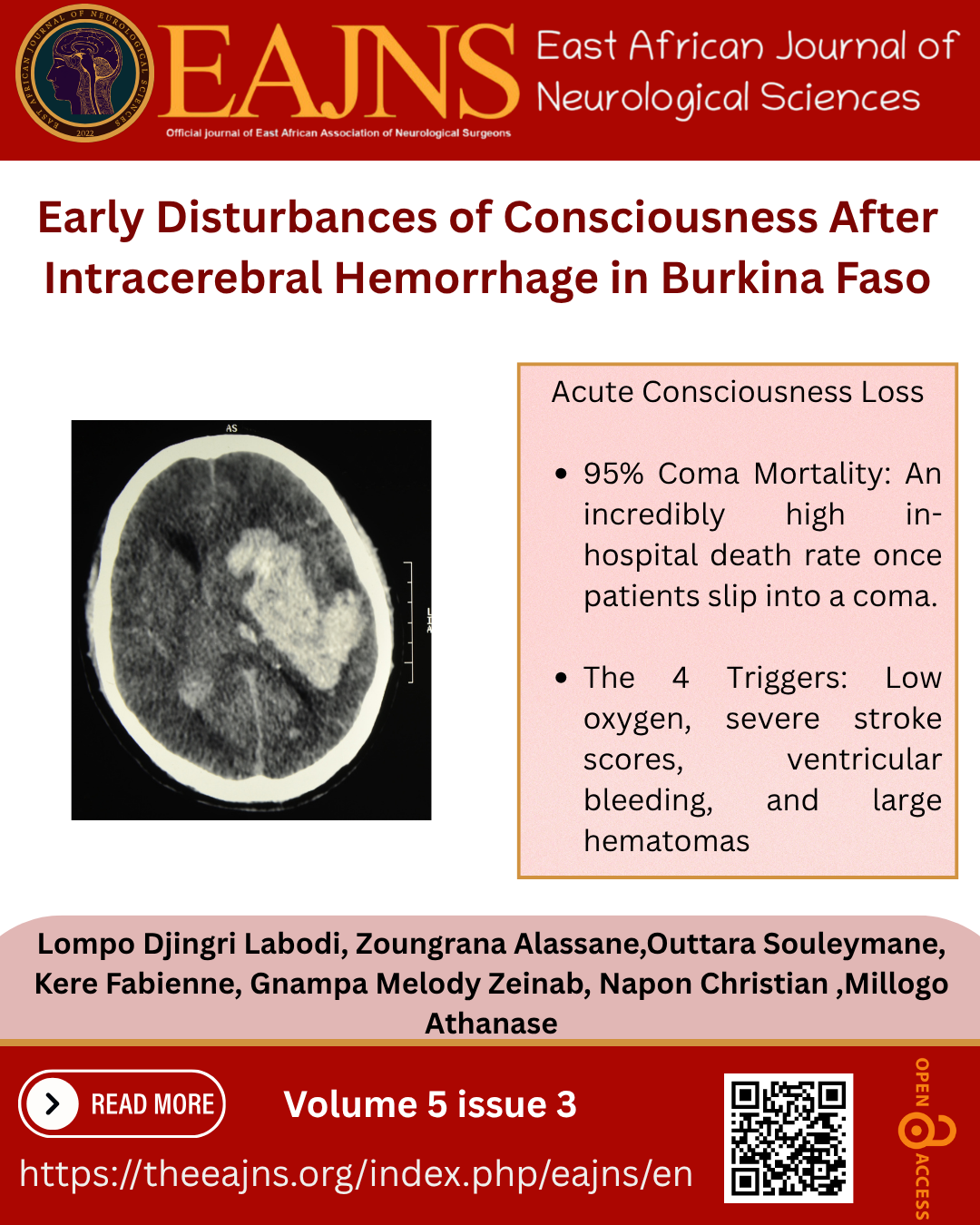
Background: Intracerebral hemorrhage (ICH) in sub-Saharan Africa is associated with high mortality, particularly in resource-limited settings. Early disorders of consciousness (EDC), occurring within the first 72 hours, are major prognostic indicators but remain understudied in Burkina Faso. Objective: This study aimed to determine the prevalence and factors associated with EDC during the acute phase of ICH in Ouagadougou. Methods: We conducted a descriptive and analytical cross-sectional study with prospective data collection from October 1, 2023, to October 31, 2024, in three university hospitals in Ouagadougou. Patients aged ≥15 years, admitted within 72 hours of symptom onset, and with CT- or MRI-confirmed ICH were included. Clinical, biological, and neuroimaging data were analyzed using multivariate logistic regression, with a significance threshold of p<0.05. Results: A total of 266 patients were enrolled, of whom 121 (45.5%) developed EDC within the first 72 hours. The mean age was 55.7 ± 13.6 years, and males predominated n(56.3%). Hypertension was the most common vascular risk factor n(69.4%). On admission, oxygen desaturation (<95%) occurred in n(42.1%) of cases, and n(38.0%) presented with coma (GCS ≤8). In multivariate analysis, independent predictors of EDC were oxygen desaturation on admission (OR 7.83; p<0.001), severe neurological deficit (NIHSS > 16: OR 5.57; p<0.001), intraventricular extension (OR 2.66; p=0.002), and hematoma volume > 30 cc (OR 2.87; p=0.004). Conclusion: Severe initial neurological impairment, oxygen desaturation, intraventricular hemorrhage, and large hematoma volume are major determinants of early disorders of consciousness, highlighting the need for intensive neurological and respiratory monitoring during the acute phase.
Downloads
References
1. Tshikwela ML, Longo-Mbenza B. Spontaneous intracerebral hemorrhage: Clinical and computed tomography findings in predicting in-hospital mortality in Central Africans. J Neurosci Rural Pract. mai 2012;3(2):115‑20. doi:10.4103/0976-3147.98205.
2. Amer HA, El-Jaafary SIM, Sadek HMAEA, Fouad AM, Mohammed SS. Clinical and paraclinical predictors of early neurological deterioration and poor outcome in spontaneous intracerebral hemorrhage. Egypt J Neurol Psychiatr Neurosurg. 2023;59(1):74. doi: 10.1186/s41983-023-00675-x.
3. Komolafe MA, Sunmonu T, Akinyemi J, Sarfo FS, Akpalu A, Wahab K, et al. Clinical and neuroimaging factors associated with 30-day fatality among indigenous West Africans with spontaneous intracerebral hemorrhage. J Neurol Sci. 15 janv 2024;456:122848. doi:10.1016/j.jns.2023.122848.
4. Limann B, Darko K, Osei EKA, Dwumfour-Poku N, Farid M, Nkansah SB, et al. Predictors of In-Hospital Mortality in Spontaneous Intracerebral Hemorrhage in a Tertiary Hospital in Ghana: A Retrospective Analysis. Neurosurg Pract. déc 2024;5(4):e00120. doi:10.1227/neuprac.0000000000000120.
5. Lompo D, Labodi DL, Kadari C, Nobila YV, Christian N, Jean KB. Intra-hospital mortality of stroke and its predictive factors in a reference hospital in Ouagadougou, Burkina Faso. Brain Nerves. 2017;1(3):1-6. doi:10.15761/JBN.1000113.
6. European Stroke Organisation (ESO). ESO guideline directory. 2020. Available from: https://eso-stroke.org/guidelines/eso-guideline-directory/.
7. Owolabi MO, Arulogun O, Melikam S, Adeoye AM, Akarolo-Anthony S, Akinyemi R, et al. The burden of stroke in Africa: a glance at the present and a glimpse into the future. Cardiovasc J Afr. 2015;26(2 Suppl H3Africa):S27-38. doi:10.5830/CVJA-2015-0384. Connor MD, Walker R, Modi G, Warlow CP. Burden of stroke in black populations in sub-Saharan Africa. Lancet Neurol. mars 2007;6(3):269‑78.
8. Connor MD, Walker R, Modi G, Warlow CP. Burden of stroke in black populations in sub-Saharan Africa. Lancet Neurol. 2007 Mar;6(3):269-78. doi:10.1016/S1474-4422(07)70002-9.
9. Abdallah A, Chang JL, O’Carroll CB, Okello S, Olum S, Acan M, et al. Validation of the Intracerebral Hemorrhage Score in Uganda. Stroke. 2018 Dec;49(12):3063-6. doi:10.1161/STROKEAHA.118.022057
10. Adeleye AO, Osazuwa UA, Ogbole GI. The clinical epidemiology of spontaneous intracerebral hemorrhage in a sub-Saharan African country in the CT scan era: a neurosurgical in-hospital cross-sectional survey. Front Neurol. 2015 Aug 5;6:169. doi: 10.3389/fneur.2015.00169.
11. Sarfo FS, Ovbiagele B, Gebregziabher M, Wahab K, Akinyemi R, Akpalu A, et al. Stroke Among Young West Africans. Stroke. Mai 2018; 49(5):1116‑22. https://www.ahajournals.org/doi/full/10.1161/STROKEAHA.118.020783.
12. Hwang BY, Appelboom G, Kellner CP, Carpenter AM, Kellner MA, Gigante PR, et al. Clinical Grading Scales in Intracerebral Hemorrhage. Neurocrit Care. 1 août 2010;13(1):141‑51. https://doi.org/10.1007/s12028-010-9382-x.
13. Togha M, Bakhtavar K. Factors associated with in-hospital mortality following intracerebral hemorrhage: a three-year study in Tehran, Iran. BMC Neurol. 14 juin 2004;4(1):9. https://doi.org/10.1186/1471-2377-4-9.
14. Qu T, Li S, Zhou X, Miao Q, Ni J, Peng B. Risk Factors for Early Poor Outcomes in In-hospital Intracranial Hemorrhage: A Retrospective Cohort Study. Neurocrit Care. 1 juill 2025; https://doi.org/10.1007/s12028-025-02306-0.
15. Zeng L, Zhang Q, Xia Z, Cui W, Guo J. Predictors of poor outcomes in patients with intracerebral hemorrhage. Front Neurol. 2025 Apr 22;16:1517760. doi:10.3389/fneur.2025.1517760.
16. Qureshi AI, Mendelow AD, Hanley DF. Intracerebral haemorrhage. Lancet. 2009 May 9;373(9675):1632 44. doi:10.1016/S0140-6736(09)60371-8.
17. deloye D, Basquill C, Aderemi AV, Thompson JY, Obi FA. An estimate of the prevalence of hypertension in Nigeria: a systematic review and meta-analysis. J Hypertens. 2015 Feb;33(2):230 42. doi:10.1097/HJH.0000000000000380.
18. Sarfo FS, Awuah DO, Nkyi C, Akassi J, Opare-Sem OK, Ovbiagele B. Recent patterns and predictors of neurological mortality among hospitalized patients in Central Ghana. J Neurol Sci. 2016 Apr 15;363:217 24. doi:10.1016/j.jns.2016.02.051
Downloads
Published
License
Copyright (c) 2026 East African Journal of Neurological Sciences

This work is licensed under a Creative Commons Attribution-NonCommercial-NoDerivatives 4.0 International License.


